Topsoil Calculator for Texas Lawns, Topdressing and Finish Grade
Enter your project dimensions
Screened topsoil and garden blend get ordered for each other constantly, and on a lawn the difference shows by the end of the first summer. Screened topsoil is mineral soil put through a mesh to take out rock, roots and clods, and it is what goes under grass and into a finish grade. Compost blend is for beds and planters, sold here as Garden Soil and sized on the soil calculator. Get that decision made first, because this page assumes the job is turf or grading, and the arithmetic starts with an area that is almost never a neat rectangle.
Measuring a front yard that has a drive down one side and a bed across the front
Nobody has a rectangular lawn. What you have is a main panel, a strip beside the drive, a piece behind the mailbox and a bed you are not covering. Measure the grass, not the lot, and take out the areas that are getting something else.
Split the shape into pieces you can measure with a tape or a wheel rather than trying to find one average. Squaring off a gentle curve is fine and overshoots by a few percent, which is the right direction to be wrong. Where a piece is genuinely round, measure across it at its widest point and use that as a diameter. Pace-counting works for a first look but is worth checking before you order, because on a 900 square foot area, ten feet of error in one direction is the better part of a cubic yard.
Five areas into one total, and a depth field that goes down to a quarter inch
Rectangle mode takes a length and a width in feet. Circle mode takes a diameter. Multiple areas mode holds up to five pieces and adds them together, which is how a split-up lawn goes in without averaging anything.
Depth accepts 0.25 to 24 inches, and the bottom of that range is the part that matters here, because a topdressing pass is measured in fractions of an inch and most calculators will not take it. Choose the material, decide about the box marked add 5% extra for compaction and spillage, then read the cubic yards, tons and cubic feet. The Email my quote button sends the figures over if you would rather not copy them down.
A quarter of an inch over living grass, four inches under a new one
Depth changes this order more than anything else on the form, so pick it before you measure.
| Job | Depth |
|---|---|
| Topdressing established turf | 1/4 to 1/2 inch, raked through so blades stay exposed |
| Overseeding | 1/2 to 1 inch |
| New lawn from seed or sod | 4 to 6 inches over a loosened subgrade |
| New flower bed | 6 inches, blended into the native soil below |
| Finish grade over fill | 4 inches, with fill dirt bringing up the level underneath |
Two of those carry conditions. Topdressing over living grass has a hard ceiling of about half an inch, because grass has to grow through it; anything more than an inch of build-up means killing or lifting the turf first, and sod buried under new soil rots unevenly and leaves lumps for a year. And a vegetable bed at 12 inches is not this material at all, that is blend, and the soil calculator sizes it.
Where the ground has to come up more than a few inches, do not buy the height in topsoil. Bring the level up with Fill Dirt, sized on the dirt calculator, and save the topsoil for the top 4 inches where roots live.
About 2,200 pounds to the yard, and why the yardage is the number to order against
This site publishes screened topsoil at about 2,200 lb per cubic yard, which is 1.10 tons to the yard, and it lists the material by the cubic yard, so the yardage is what you order and the tonnage tells you what is landing on your drive.
The chain is the same one across these tools. Square feet times depth in inches, divided by 12, gives cubic feet. Divide by 27 for cubic yards. Multiply by 1.10 for tons. Coverage from a single yard follows: about 648 square feet at a half-inch topdressing, 162 at 2 inches, 108 at 3, 81 at 4 and 54 at 6. Rain changes what a shovelful weighs, not what a yard covers, so a wet load is not a bigger load. It is a harder one, since soaked topsoil smears instead of raking, which is the argument for having it delivered in the week you plan to spread it.
Nine hundred and thirty-eight square feet of new lawn, and a topdressing pass after a hard summer
Both of these are hypothetical, with the working shown.
A front lawn going in over stripped ground, entered as two areas: a main panel 38 by 19 feet is 722 square feet, and a strip beside the drive 24 by 9 feet is 216, for 938 square feet in total. At 4 inches: 938 x 4 / 12 = 312.67 cubic feet, 312.67 / 27 = 11.58 cubic yards, 11.58 x 1.10 = 12.74 tons. Tick the 5 percent box for the edges and low spots and it reads 12.16 cubic yards and 13.38 tons.
A topdressing pass across 3,750 square feet of established turf at a half inch: 3,750 x 0.5 / 12 = 156.25 cubic feet, 156.25 / 27 = 5.79 cubic yards, 5.79 x 1.10 = 6.37 tons. The same lawn at 4 inches would be close to 46 cubic yards, which is the clearest illustration on this page of what the depth field is worth.
Checking a load, and spreading it over clay that would rather shed water
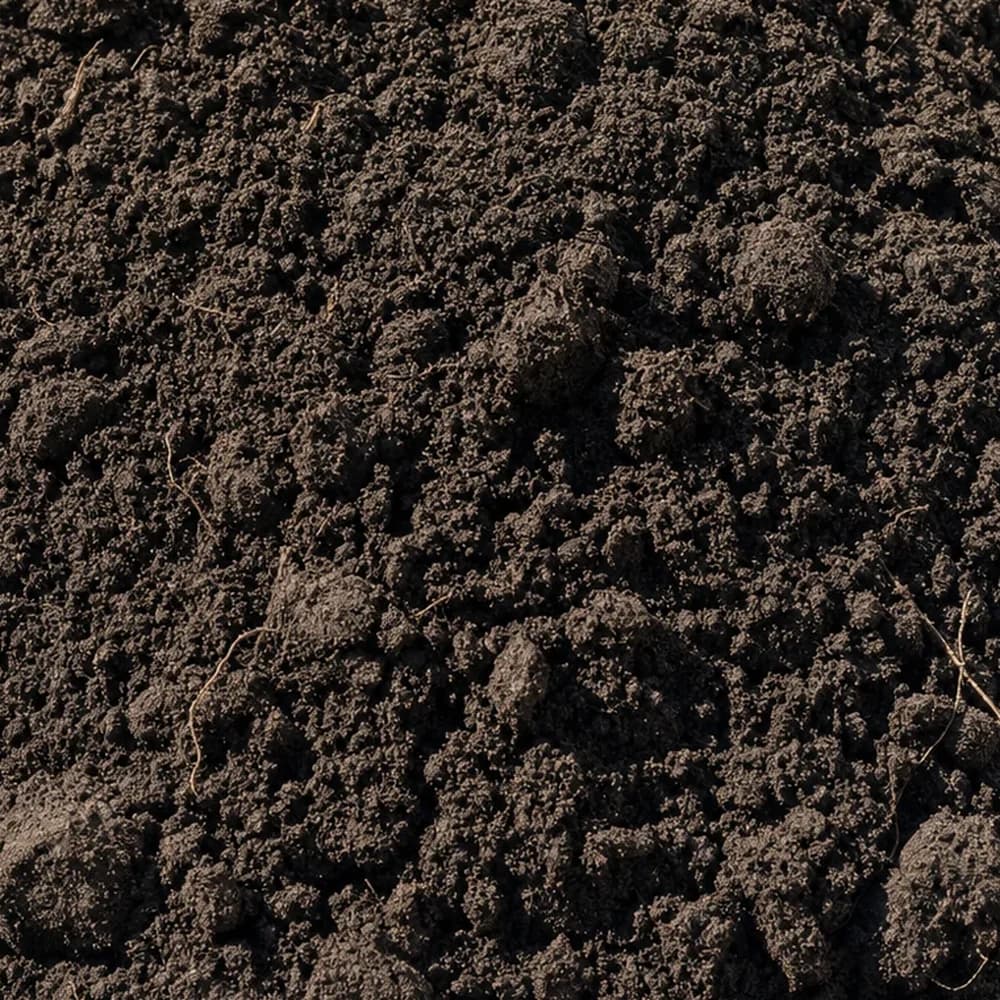
Look at what comes off the truck before it goes down. Good screened topsoil is dark, breaks apart in the hand and smells earthy rather than sour. Squeeze a damp handful: it should make a loose ball that falls apart when you poke it. A slick ribbon means heavy clay in the mix, and material that will not hold a ball at all is mostly sand. Gray color or a swampy smell points to wet, airless storage, and visible white rhizomes bring weeds with them. Photograph anything that looks off before you spread it.
Spreading matters as much as the soil. Break up the surface an inch deep before the topsoil goes on, because a clean layer laid on sealed clay drains like a bathtub with the plug in, and roots stop dead at that boundary. Keep water heading away from the house with roughly a 6 inch drop over the first 10 feet. Firm it lightly rather than compacting it: a footprint in settled topsoil should sink about half an inch. Delivery is arranged at checkout by ZIP code, the truck needs firm ground to tip on and a clear way out, and a tarp under the pile saves cleaning the drive afterwards. When the numbers are set, open Top Soil, choose a quantity and a date, and order.
Common questions
Where does twelve yards of topsoil go on an ordinary suburban lot?
Somewhere firm, close to the largest part of the lawn, and off the area you are about to seed. Twelve yards covers more of a driveway than people picture and will sit there for as long as it takes you to move it, so a tarp underneath and a wheelbarrow route that avoids soft ground are worth planning before the truck arrives.
The result shows cubic yards and tons. Which one am I ordering?
Screened topsoil is listed by the cubic yard, so the yardage is the order. The tonnage is there so you know the weight arriving, which is what decides where it can be tipped and how long the spreading will take.
Is the depth I type the depth before raking or after?
Type the finished depth you want in place. Topsoil is firmed lightly rather than compacted, so the two are close. The 5 percent option covers what fills low spots and disappears at the edges, which on a lawn is usually the honest difference.
There is a round bed in the middle of the lawn. How do I add it?
Use circle mode with the diameter in feet. A 13 foot round bed at 4 inches is about 132.7 square feet, 44.2 cubic feet, 1.64 cubic yards and 1.80 tons. Enter it as one of your five areas if it is going in with the lawn, or run it separately if it is getting a different depth.
Can I work the total out on paper to be sure?
Multiply the area in square feet by the depth in inches, divide that by 12, and divide the answer by 27. That is your cubic yards. Multiply by 1.1 for tons. A half-inch topdressing is the one to double check, since 0.5 divided by 12 is a small number and it is easy to type a whole inch by accident.
Related calculators
Lawn math done? Soil's on us to deliver.
Screened topsoil by the cubic yard, free delivery across Texas.