Mulch Calculator for Texas Beds, Tree Rings and Bare Ground
Enter your project dimensions
A tape measure round the beds on a Saturday morning answers most of this before you open anything. Mulch is the cheapest thing you can put between a Texas August and a root ball, and the whole question is how many yards it takes to hold two or three inches across ground you can already see. Here is a full job worked through the mulch calculator, then the tool that did it.
Sixty-two feet of foundation bed at three inches
Take a hypothetical set of beds running along the front and one side of a house, 62 ft of bed at an average 3.5 ft deep from wall to edge, going on bare soil at 3 inches.
- Area: 62 x 3.5 = 217 square feet
- Cubic feet: 217 x 3 / 12 = 54.25
- Cubic yards: 54.25 / 27 = 2.01
- Bag equivalent: 2.01 x 13.5 = about 27 bags of 2 cubic feet
Five tree rings, 6 ft across each, at the same depth: each ring is 28.3 square feet, so five come to 141.4 square feet, 35.3 cubic feet, 1.31 cubic yards, near enough 18 bags. Same depth, so the beds and the rings go through in one run, and the morning's work is about 3.3 cubic yards. That is one pile, or a cart pushed through the garden center forty-five times.
Feeding the mulch calculator a bed that curves
Beds are rarely rectangles, and there are three shape modes to get around it. Rectangle takes length and width in feet. Circle takes a diameter, which is the setting for a tree ring or a round island bed. Multiple areas stacks up to five separate pieces and totals them, so the front beds, the side run, the island and two rings go in as one estimate rather than five sums on the back of an envelope.
For a bed that curves, measure its length along the middle of the curve and use an average width from edge to wall. The error from doing that on a garden bed is smaller than the error from eyeballing the depth, which is the number that really moves the answer.
Depth takes anything from 0.25 to 24 inches, but only a narrow band of that is useful:
| Situation | Depth |
|---|---|
| Refreshing last year's layer, raked loose first | 2 inches |
| Bare or newly planted ground | 3 inches |
| The upper limit anywhere in the bed | 4 inches |
| Playground surfacing, using certified chip | 6 inches or more |
Past 4 inches the layer starts working against you. Roots want air, and a thick wet mat over them in a humid stretch is the fastest way to lose a shrub you were trying to protect.
Why the tons reading looks broken
Run any of the above and the tons figure comes back at a fraction of what you would see for stone. That is correct. Shredded mulch is published at about 600 lb per cubic yard on this site, which is 0.30 tons, while crusher run at the other end of the range is 3,000 lb and 1.50 tons. The same cubic yard, five times the weight.
So read the yards, not the tons. Mulch is a volume product, the truck fills up long before it weighs out, and 27 cubic feet make a cubic yard no matter what is in it. That last figure is the one worth carrying: 27 cubic feet is exactly 13.5 of the 2 cubic foot bags, or 9 of the 3 cubic foot bags.
Coverage, per cubic yard: 324 square feet at 1 inch, 162 at 2 inches, 108 at 3 inches, 81 at 4 inches.
The half yard for the beds behind the garage
The five percent tick on the form covers spillage, which on mulch means what the wheelbarrow throws on the lawn and what the wind takes. It is worth having on. What it does not cover is the bed you forgot, and there is always one: the strip behind the garage, the run along the side fence, the two pots by the gate.
Round up to the next half yard for those. A little left over goes under a tarp and gets used within the week. Ordering exactly to the measurement means stopping with the last bed bare and deciding whether it is worth a second trip.
Allow the time, too. A yard of mulch is roughly half an hour to forty-five minutes of wheelbarrow work, so three yards is most of an afternoon.
Shredded hardwood against the dry months, and beds that shed water
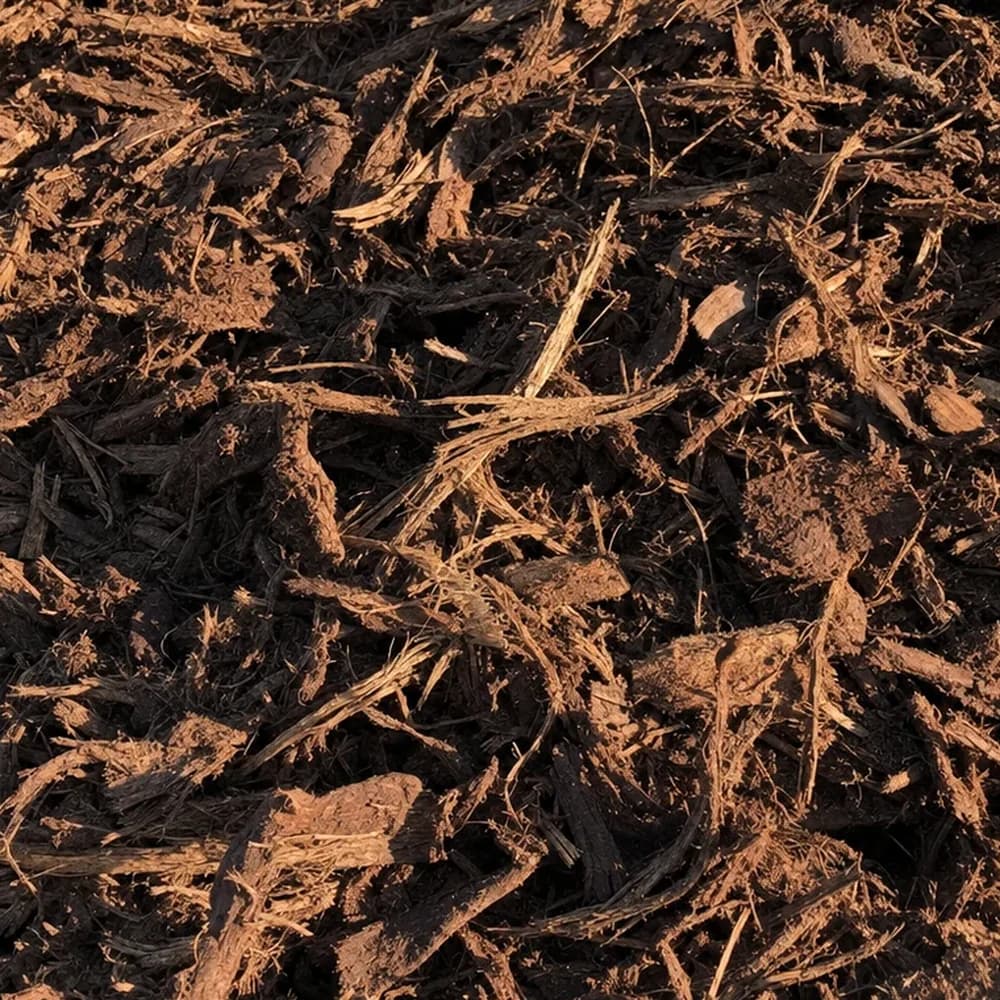
The calculator is set for shredded hardwood, which knits together as it settles and holds its place on a mild slope. That matters more here than the look of it. A hard, fast downpour will float loose chip and nuggets straight out of a bed and leave them across the drive, while a matted shredded layer mostly stays put and keeps soil moisture where it is through a long dry stretch.
Every mulch type uses the same volume arithmetic, so the yardage does not change if you switch. What changes is how long it lasts and how often you are back out there. Shredded Mulch is the product this page is set for. Some front beds get river rock instead, which never has to be refreshed and never feeds the soil either.
If a bed is being built rather than topped up, the layer underneath is its own order. The topsoil calculator sizes what goes in over heavy clay before planting, and garden soil is the blend for raised beds and planters.
Two placement rules are worth more than the depth argument. Keep a clear ring of 3 to 6 inches around every trunk, flat like a doughnut rather than heaped like a cone, because bark held damp will rot and cover at the base invites rodents. And keep the layer down to 2 or 3 inches within about 6 inches of siding, below the slab line, so a thick damp band is not sitting against the house.
Getting the pile off the drive before it heats
Email the estimate to yourself if you want it while you are out at the beds, then open the product page, set the yardage and a date, and give the ZIP at checkout, which is where delivery is arranged. A three-yard pile is about the footprint of a small car, so clear that much driveway and put a tarp down first, since fresh shredded mulch will stain concrete.
Then spread it within a week or two. Left in a deep pile through a warm spell, the middle heats and sours, and you will smell it before you see it. If the beds are only part of the plan, the calculator hub has the tools for the soil and stone going in alongside them.
Common questions
What if I come up a bed short?
You will know by mid-morning, because the last bed is the one nearest the house. Order to the next half yard above the estimate rather than exactly to it. Spare mulch keeps under a tarp for a couple of weeks and goes on the beds you did not measure.
How accurate is a yardage taken off curved beds?
Accurate enough. Bed edges wander by a few inches and it barely moves the total. Depth is the sensitive number, and the gap between an intended 2 inches and an actual 3 is half as much material again.
Which product page do I order from once I have the yards?
Shredded Mulch, which is what the calculator is set to and what the coverage figures assume. Quantity and the delivery date are both set there.
Where should a mulch load be dropped?
On the driveway or another hard surface within wheelbarrow reach of the beds, on a tarp, and not on the lawn. A pile left on grass for two weeks kills what is under it, which turns one job into two.
Why does it show tons at all for mulch?
Because the same tool serves stone, soil and mulch, and it reports every material in yards, tons and cubic feet. For mulch, use the yards and the bag equivalent. The tonnage is real but small, and nobody buys mulch by weight.
Related calculators
Skip the 27-bag cart.
Bulk shredded hardwood by the yard, tipped in your driveway, delivery free.