Bulk Material Delivery: Access, Ground and the Texas Year
Walk to the point where a truck would leave the road and take two measurements. Across the entry, you want a clear twelve feet. Straight up, you want nothing in the way, which in practice means the low limb on the live oak and the service drop running to the barn. Almost every delivery that goes sideways goes sideways on one of those two numbers, and both can be checked with a tape and thirty seconds of looking before you place the order.
Twelve feet across, and nothing hanging over it
A dump truck needs a clear twelve-foot route from the road to the drop, with no low branches and no overhead wires. Width is usually the easy part on a suburban drive and the hard part at a ranch gate, where a cattle guard, a gate post or a pair of cedars has narrowed the opening since the last time anything wide came through. Overhead is the opposite: people measure the gate and forget the tree.
Check the turn as well as the run. A truck that fits through the gate still has to swing, and a bed that comes up to tip needs room above it as well as behind it.
What a wet week does to the ground underneath
This is the part of the year that decides where a load can go. Clay that has taken several days of rain will carry a pickup and rut under a loaded truck, and a pasture track that looks solid from the porch can be soft twenty feet in. Work runs year round through most of the state, so it is a wet spell rather than a cold snap that costs you a delivery date.
The practical answer is to give the ground a couple of dry days before the truck comes, and to pick a drop spot on the firmest surface within reach of the work rather than the closest one. A driveway, a caliche pad or a compacted apron will take the weight when a lawn or a field gate will not.
Cracked clay, summer heat and where the pile should land
By late summer the problem reverses. The ground is hard enough to drive anywhere, and clay has shrunk and opened cracks, which matters less for the truck than for what you do next. Material tipped onto bare clay in August wants moving quickly, because a pile left on grass through two hot weeks kills what is under it.
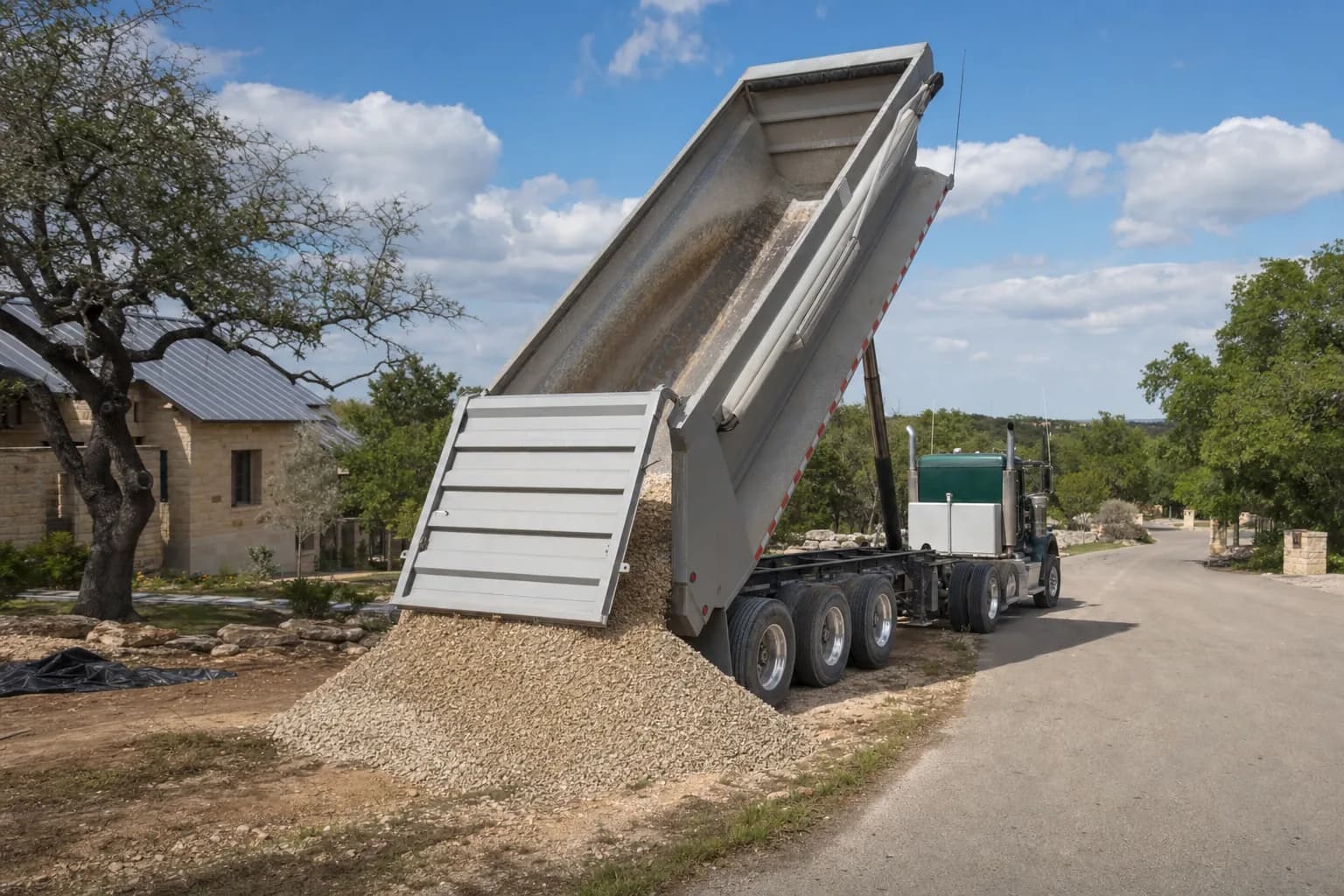
Put the drop where the shortest wheelbarrow run is, on a surface you do not mind losing for a day or two. The driver places the material as a single pile at the spot you mark, so the marker is the plan. A cone, a flag or a stake the driver can see from the cab is enough, and the unloading itself is a matter of ten to fifteen minutes.
Choosing a date and reading the note that comes back
Delivery dates are chosen at checkout along with the material and the quantity, and the delivery ZIP code is what the site uses to work out what applies at your address. Dates offered run Monday through Friday, and there is a field for where the load should be dropped. Free delivery, where it applies, is the site's current delivery offer, shown at checkout.
After the order goes through it is matched to a supplier in the network near that address, and an agent contacts you to confirm the exact delivery address. The confirmation names the date you chose and a local contact. You do not need to be on site, but leave the route open, leave the marker in place, and keep your phone with you, because the driver may call or text to confirm placement before tipping.
When the truck cannot reach the spot you wanted
Backyard placement works when the truck can get to level, unobstructed ground and get back out again. Where it cannot, the material goes as close as the driver can safely place it, which usually means the driveway or the ground beside it. That is worth knowing before the day rather than on it.
If you already suspect the approach is tight, soft or overhung, say so before you order. Send the gate width, the overhead clearance and a description of the surface through the contact form with the ZIP. To check what applies at your address, enter the ZIP on any product page or the Texas delivery areas page, then size the load with the material calculator before you pick a date. The ordering questions cover changes and the published refund policy.
Common questions
The gate is narrowed by a cattle guard and a pair of cedars. What do I measure?
The gap between the cedars at mirror height rather than at the ground, and the length of the cattle guard. A guard that a pickup crosses daily is a different question under a loaded rear axle, and cedars take their width out of the opening above head height where nobody looks. If either is marginal, mark a drop on the road side of the gate and put it in the drop instructions.
Is there a time of year when delivery access is easier?
Access follows the rain rather than the calendar in most of the state, since work here runs year round and it is wet spells that stop a job. A dry stretch firms up tracks, pasture gates and unpaved approaches, which is when a loaded truck can get closest to the work. After several days of rain, plan on dropping on a hard surface and moving the material yourself.
The caliche pad is firm but the last hundred feet is pasture track. Where does the load go?
On the caliche. A pasture track that looks solid from the porch is often soft twenty feet in, and a loaded truck finds that out before you do. Take the drop on the pad and move it out with a tractor bucket, or wait for a dry stretch if the track is the only route to where the Flex Base has to end up.
The confirmation names a local contact. What is that for?
Anything about the delivery that has changed since you ordered: the gate, the surface, who is on site. Raise it as early as you can rather than on the morning, because a load already scheduled is harder to alter than one still being arranged. A shortfall is usually a second order rather than an amendment, and cancellations run under the published refund policy.
Ready to Place an Order?
All orders come with free delivery. Look through the products, try the calculator, then place an order today.