Crusher Run Calculator for Texas Pads, Lanes and Drive Bases
Enter your project dimensions
Black clay swells through a wet spring and draws back in August, and a base course laid thin over it will dish, crack and start holding water by the second summer. The crusher run calculator settles the one part of that job you can fix before anything rolls: give it a footprint and the depth you want after compaction, and it hands back cubic yards, tons and cubic feet for crushed limestone base.
What does the crusher run calculator need me to measure on a pad or a lane?
Pick the shape first. Rectangle asks for length and width in feet. Circle asks for a diameter. Multiple areas lets you stack up to five separate pieces and adds them together, which is the setting for a pad with an apron off one corner, or a lane that doglegs around a barn and widens where the trailer swings.
Measure the width you will really use, not the width of the finished surface. A pad you intend to drive a loaded truck onto needs shoulder, and rock spread by a box blade always creeps past the string line. Adding a foot to each side of a 24-foot pad is about 50 extra square feet, which is worth more than guessing at it later.
How thick does crushed limestone base sit once it is rolled?
Enter compacted depth, not the loose pile you will dump. The calculator has no way of knowing the difference, so the number you type is the number the spec should say.
| What is going on top | Compacted depth |
|---|---|
| Pavers, flagstone, a garden path | 4 inches |
| Car and light pickup drive | 4 to 6 inches |
| Truck, trailer or equipment traffic | 6 to 8 inches |
| Any of the above over soft or freshly cut clay | Add 2 inches |
Place it in 2-inch lifts and compact each one. A single thick pour looks the same on the day and behaves nothing like it in three years. Mist each lift before the plate or roller goes over it, because material with fines in it binds far better damp than dry, and in Texas heat a dry lift sheds moisture faster than you can compact it.
What does a yard of this material weigh?
The site publishes about 3,000 lb per cubic yard for crusher run and road base, which is 1.50 tons, and that is the figure the calculator applies. Those weights are approximate, and they are what separate one estimate from another on an identical footprint.
| Material | Per cubic yard | Tons per yard |
|---|---|---|
| Crusher run and road base | about 3,000 lb | 1.50 |
| Stone screenings | about 2,900 lb | 1.45 |
| #57 and 3/4 inch crushed stone | about 2,800 lb | 1.40 |
The fines are the reason for the weight. They fill the voids between the stone, which is what lets the layer lock up under a roller, and also why the same volume weighs more than clean washed stone.
Do I need the ten percent box on a base I am going to roll?
Yes. The "add 10% extra for compaction & spillage" tick, on by default, is there for exactly this case: loose material tightens as it is rolled, and some of it ends up on the grass beside the pad. If you have entered the finished depth and you intend to compact, leave it on. For a thin leveling course you will not roll, it makes little difference either way.
Rounding is the other half of it. Coming up short on a base means a second delivery for a fraction of a load, and a cold joint where the new material meets the old. A little left over goes into the low corner that always shows up after the first gully washer.
What does the arithmetic look like on a 36 by 24 equipment pad?
Take a hypothetical laydown pad, 36 ft by 24 ft, built to 6 inches compacted because a skid steer and a gooseneck will sit on it.
- Footprint: 36 x 24 = 864 square feet
- Cubic feet: 864 x 6 / 12 = 432
- Cubic yards: 432 / 27 = 16.0
- Tons: 16.0 x 1.50 = 24.0
With the ten percent box ticked, that reads 17.6 cubic yards and 26.4 tons. Split across two 3-inch lifts, each pass takes roughly 13.2 tons, which is worth knowing before you decide where the first half of the pile goes.
Is crusher run the right pick, or do I want Flex Base?
Either, and the tonnage is the same. They are two names for one job here, both published at 1.50 tons per cubic yard, so what decides it is the name on your plan set.
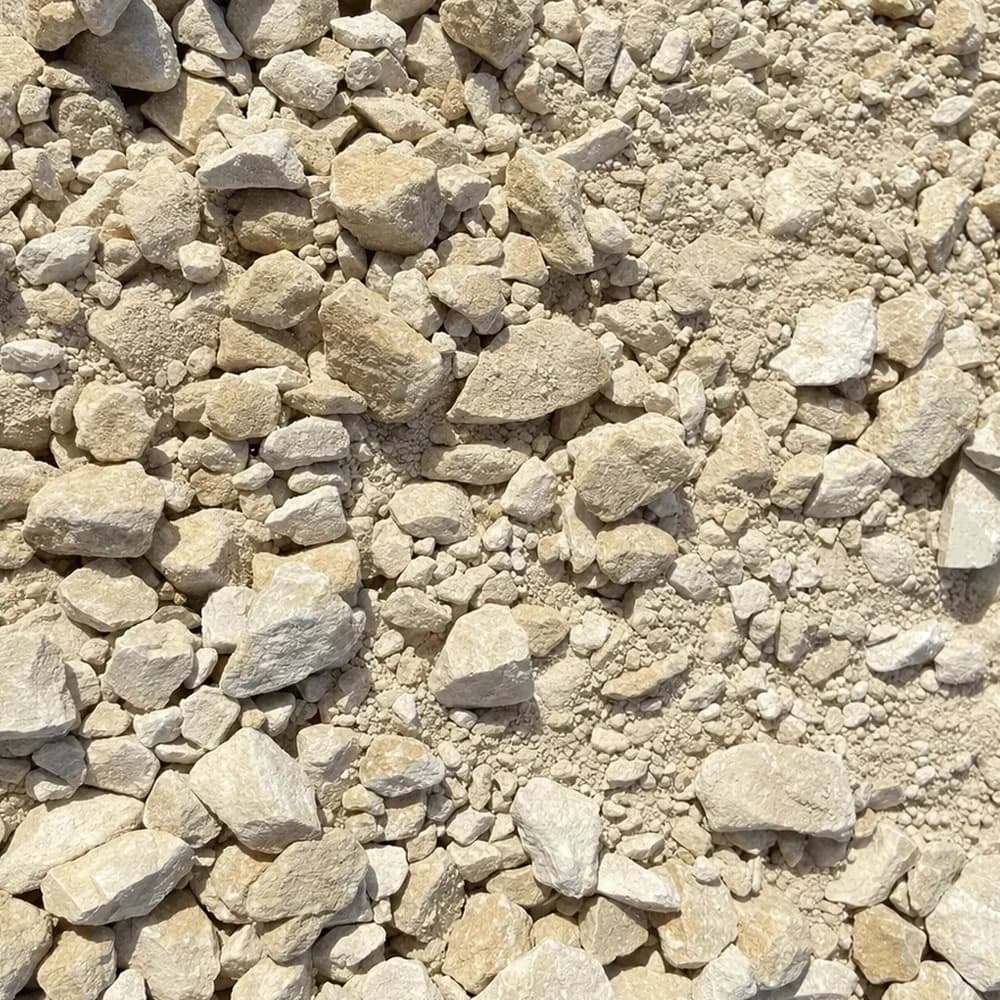
Flex Base is how base material is specified across the state, under the TxDOT Item 247 flexible base description, by type and grade. That is the language your ground crew and your plan set will use, and the road base calculator is the tool to open if that is what you are buying. Crusher Run is the crushed limestone base, sometimes written on a ticket as crush and run or 2 inch minus, and it is what this page sizes.
What it is not for is drainage. The fines that make it compact also make it hold water, so a French drain or a trench behind a wall wants drain rock or #57 limestone instead, sized on the stone calculator. If pavers are going on top, the paver base calculator adds the perimeter allowance this one does not.
What happens between the estimate and the pile on your pad?
Send the result to yourself with the Email my quote button if you want it on your phone at the site, then open the product page, set the quantity and the date you want it, and enter the delivery ZIP at checkout. Delivery is arranged there. The driver needs a clear run to the dump spot and firm ground to stand on, which on clay means not the morning after a storm.
Common questions
How close is this estimate to what I will actually use?
Close on a flat, stripped footprint measured properly. It is volume arithmetic, so it is only as good as your depth and your dimensions. The things that pull it off are an uneven subgrade, ruts you have not filled, and a spread that creeps wider than the string line.
Should I type the loose depth or the compacted depth?
Compacted. Enter the depth you want the base to measure once it has been rolled, then leave the ten percent option on so the order allows for the material tightening and for spillage.
Why does it give me tons and cubic yards for the same job?
Yards describe the space the base has to fill, which is what you measured. Tons are how bulk material is sold and loaded. You size the job in yards and you buy in tons, and the weight per yard is what converts between them.
Which product page should I open once I have a number?
Crusher Run for the crushed limestone base this calculator is set for, or Flex Base if that is what your plan calls out. Quantity and delivery date are set on the product page itself.
Where should the load go on a site that is still being worked?
Pick a spot on firm ground within reach of the far end of the pad, not on top of the footprint you are about to build. Working a spread downhill and away from the pile saves a surprising amount of handling, and stone sitting on the pad has to be moved twice.
Related calculators
Base tonnage sorted? Good.
Crusher run by the ton, the cheapest structure on the yard, delivered free.