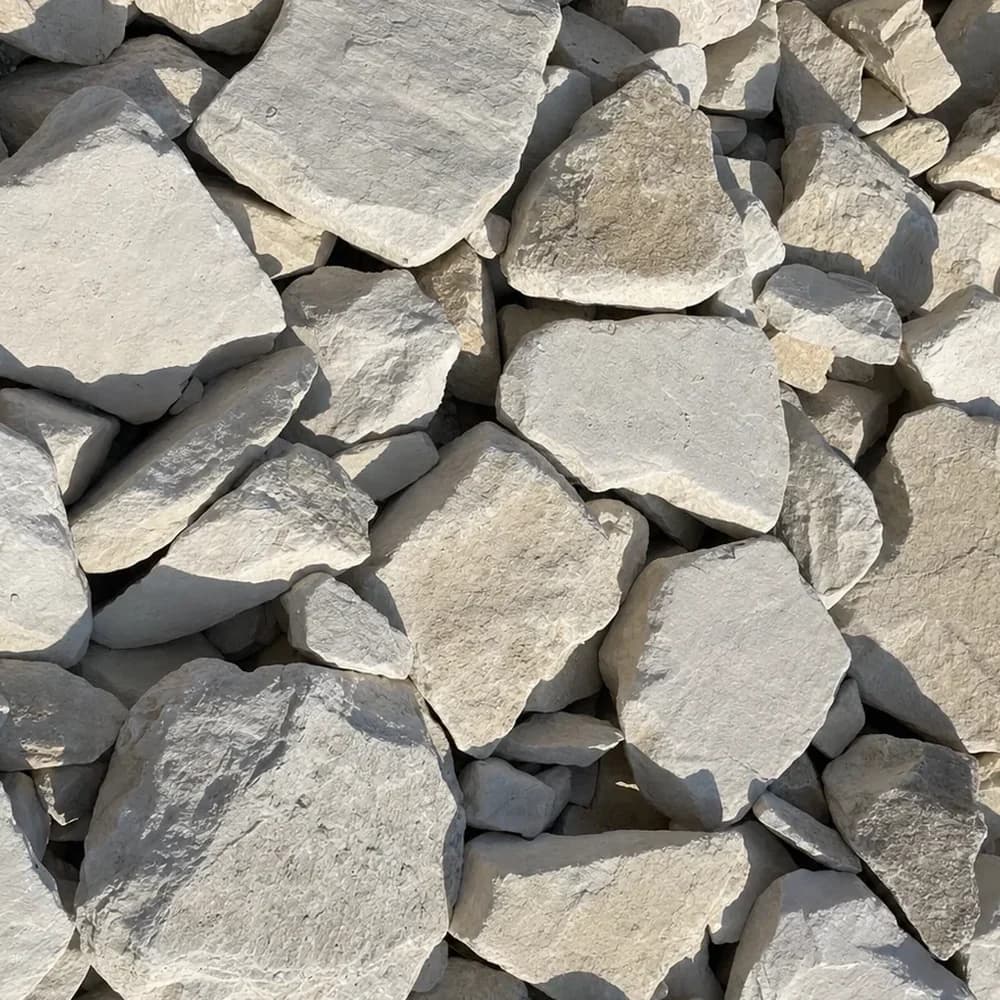
Rip Rap Calculator for Texas Banks, Tanks and Outfalls
Enter your project dimensions
Bank work has a window, and it is not a season so much as a gap. Water level drops through a dry stretch, the cut the last high-intensity rain took out of the bank is exposed, and there are a few weeks to get stone into it before the next round of runoff finds the same weakness and takes another foot. The rip rap calculator turns that exposed face into a tonnage you can order against while the ground is still firm enough to drive on.
| The job in front of you | Stone layer thickness |
|---|---|
| Downspout or culvert outfall onto clay | 12 inches |
| Stock tank edge, cut by wave action and hooves | 12 to 18 inches |
| Creek or draw bank scoured by flash runoff | 18 inches |
| Channel with fast water, or stone larger than 12 inches | 24 inches |
Twelve inches is the practical floor for erosion protection, and the working rule behind the whole table is that the layer runs 1.5 to 2 times the largest dimension of the stone you are placing. Anything specified on a plan set, a spillway or a highway job, follows the plan rather than this page.
What the rip rap calculator needs is the slope face, not the map view
This is the measurement that separates an armor estimate from a landscape one. Run the tape down the face of the bank from the toe to the top of the protected zone, not across level ground beside it, then multiply that slope distance by the length of shoreline or channel you are covering. A bank that reads 4 feet wide on a plan is about 4.5 feet of face at 2:1, and more on anything steeper, and over a 50 foot run that difference is tons.
Enter the result through Rectangle, giving the shoreline length and the slope distance as length and width in feet. Multiple areas takes up to five sections at once, which is how a bank that turns a corner, or a bank plus the apron below a pipe, goes in as one number instead of two guesses. Circle mode has little use here. Depth accepts 0.25 to 24 inches, so the 24-inch layer at the bottom of the table is the deepest single pass the tool will take.
Sixty-five feet of tank bank, and the apron below a pipe
Two hypothetical jobs, both worked through.
A stock tank bank. 65 ft of shoreline with a 7 ft slope face, armored at 18 inches:
- Slope-face area: 65 x 7 = 455 square feet
- Cubic feet: 455 x 18 / 12 = 682.5
- Cubic yards: 682.5 / 27 = 25.3
- Tons: 25.3 x 1.55 = 39.2
A culvert apron. A 24-inch pipe discharging onto clay, with the apron carried six pipe diameters out, so 12 ft long by 7 ft wide, at 18 inches:
- Area: 12 x 7 = 84 square feet
- Cubic feet: 84 x 18 / 12 = 126
- Cubic yards: 126 / 27 = 4.67
- Tons: 4.67 x 1.55 = 7.23
Under both of those goes a bedding layer, which is not optional on clay. Either non-woven geotextile, sourced from a landscape supplier, or 3 to 4 inches of #4 crushed stone. For the 455 square foot bank, 4 inches of #4 works out at 5.62 cubic yards, about 8.2 tons at the published 1.45 tons per yard. Stone set straight onto a clay bank looks solid for a season and then settles, because the soil under it keeps washing out through the gaps.
Before the toe goes in below the ordinary high water line of a creek, stock tank or bay shoreline, check what approval your state and local authorities require. Work in and along water is commonly permitted work.
Place the toe first and set the lowest stones below the waterline or below the depth you expect scour to reach, since failure almost always starts at the bottom and works up. Shape the bank to 2:1 or flatter before any stone goes down; steeper than that is an engineering question, not a question of more rock. Set the exposed top course so the stones lock against each other rather than leaving them where the bucket dropped them.
Why 3,100 pounds a yard changes the size of the order
Rip rap is the heaviest material on this site's weight table at about 3,100 lb per cubic yard, which is 1.55 tons. Set against the others, that is where the tonnage comes from:
| Material | Per cubic yard | Tons per yard |
|---|---|---|
| River rock, 1 to 3 inch | about 2,700 lb | 1.35 |
| #57 and 3/4 inch crushed stone | about 2,800 lb | 1.40 |
| Crusher run and road base | about 3,000 lb | 1.50 |
| Rip rap and armor stone | about 3,100 lb | 1.55 |
Weight is only half of it. The other half is depth. A decorative bed takes 2 or 3 inches and a bank takes 12 to 24, so a ton of armor stone covers around 17 square feet at 12 inches and about 9 at 24, against well over 100 for a shallow landscape layer. That is why an area that sounds small on a tank edge turns into a serious load.
If the job is decorative rather than structural, this is the wrong page: a dry creek bed that has to look like one, rather than survive one, is large river rock laid a few inches deep and sized on the river rock calculator.
Stone size follows the water. Four to eight inch rock suits pond and tank banks, downspout outfalls and slow-moving water. Eight to twelve inch is for lake edges taking boat wake and faster channels. Caught between two sizes, take the larger stone and thicken the layer to match, because the extra weight is what buys the margin.
Where the extra tonnage should actually go
The five percent tick for compaction and spillage does no harm, but it is not the allowance that matters here. Armor stone is not compacted.
The real cushion is in the measurement. Round the slope distance up rather than down, because the face is never as straight as the tape suggests, and carry the armor a foot or two past each end of the damaged section so the water cannot simply start cutting where the stone stops. Keep a few tons in reserve near the bank as well. After the first heavy rain the toe usually wants a handful of stones put back, and filling a thin patch in the week it appears is a different job from rebuilding it a year later.
Ten minutes of inspection a few times a year is the whole maintenance program. Look for displaced rock at the toe, soil showing between stones, and any fabric that has worked its way into daylight.
Getting armor stone down to the water
Email the estimate to yourself, then open the RipRap product page, set the tonnage and a date, and give the delivery ZIP at checkout. Check the approach before you order: the last stretch down to a tank or creek crossing is where a loaded truck bogs down, and stone moved twice costs twice. Give it dry days on a clay approach. If the bank is being protected as part of a larger drainage job, the stone calculator covers the trench and drainage material that usually goes in alongside it. A bank you are not sure how to size can go through the contact page with your measurements.
Common questions
Why does the same 18 inches need far more tonnage in rip rap than in river rock?
Because the weight per yard is different and so is the depth the job calls for. Armor stone runs about 1.55 tons per cubic yard against 1.35 for river rock, and a decorative bed is 2 or 3 inches deep where a bank is 18. The volume difference does most of the work; the weight difference finishes it.
Is the five percent option enough of a margin for a bank?
Not on its own. It covers spillage, which is minor here. Build your margin into the slope-face measurement and by extending the armor past both ends of the cut, and keep a few tons back for the first repair after a storm.
How do I measure a slope properly?
Run the tape down the face itself from the toe to the top of the zone you are protecting, following the ground rather than pulling a straight line through the air. Multiply that by the length along the bank. Using the flat width instead is the most common way these orders come up short.
The bank turns a corner. Do I use the multiple-areas option?
Yes. Enter each straight run as its own area with its own slope face and layer thickness, up to five at a time, and the tool adds them. It is more accurate than averaging a corner, and it lets you thicken only the stretch taking the hardest flow.
Do I include the ground above the bank in the measurement?
Only the part that gets stone. Armor the face, the toe and a foot or so over the top edge where water spills across, then stop. Beyond that the protection is vegetation and grading, not rock, and paying for stone up the pasture is money in the wrong place.
Related calculators
Banks don't armor themselves.
RipRap by the ton with free delivery, plus the #4 bedding stone to go under it.