Pea Gravel Calculator for Texas Patios, Runs and Play Areas
Enter your project dimensions
Pace out the side yard where the dogs have worn the grass to bare clay and you have already done the hard part of this job. It is a rectangle, it wants three inches of rounded stone, and everything else is arithmetic. Here is that job through the pea gravel calculator first, then the tool and the depths behind it.
Two and a half tons down the side of the house
A hypothetical dog run, 22 ft long by 9 ft wide, surfaced at 3 inches:
- Area: 22 x 9 = 198 square feet
- Cubic feet: 198 x 3 / 12 = 49.5
- Cubic yards: 49.5 / 27 = 1.83
- Tons: 1.83 x 1.40 = 2.57
Tick the five percent box for spillage and it reads 1.93 cubic yards and 2.70 tons. Round to 3 tons and the spare goes along the strip against the fence, which is where it wears thin first.
Now change one number. Same stone under a swing set, where a fall zone wants a full 12 inches: an 18 by 13 ft area is 234 square feet, 234 cubic feet, 8.67 cubic yards, 12.1 tons. Four times the depth and nearly five times the load, off an area barely larger than the dog run.
What the pea gravel calculator wants from a run, a ring or a fall zone
Three shapes cover almost everything this stone is used for. Rectangle takes length and width in feet, which handles runs, paths and patios. Circle takes a diameter, which is the setting for a fire ring surround or a tree-shaded seating spot. Multiple areas totals up to five pieces in one go, so a patio, the path leading to it and two rings come back as a single tonnage.
Depth goes in inches, anywhere from 0.25 to 24, and it is the number that decides the answer:
| Where it is going | Depth |
|---|---|
| Walkway, patio, dog run, fire ring | 2 to 3 inches |
| Below 2 inches | Ground shows through within a season |
| Above 3 inches | Walks like loose beach sand underfoot |
| Playground fall zone | 9 to 12 inches, and check the equipment manual |
The fall-zone row is the one that needs saying out loud: what this page sizes is landscape pea gravel, it is not sold as certified playground surfacing, and the required depth, the fall-zone footprint and the maintained depth all come from the equipment manufacturer's instructions rather than from us.
Set the material, decide on the optional five percent for compaction and spillage, and the result comes back in cubic yards, tons and cubic feet, with a button to send the estimate to yourself.
Rounded stone weighs what crushed stone weighs
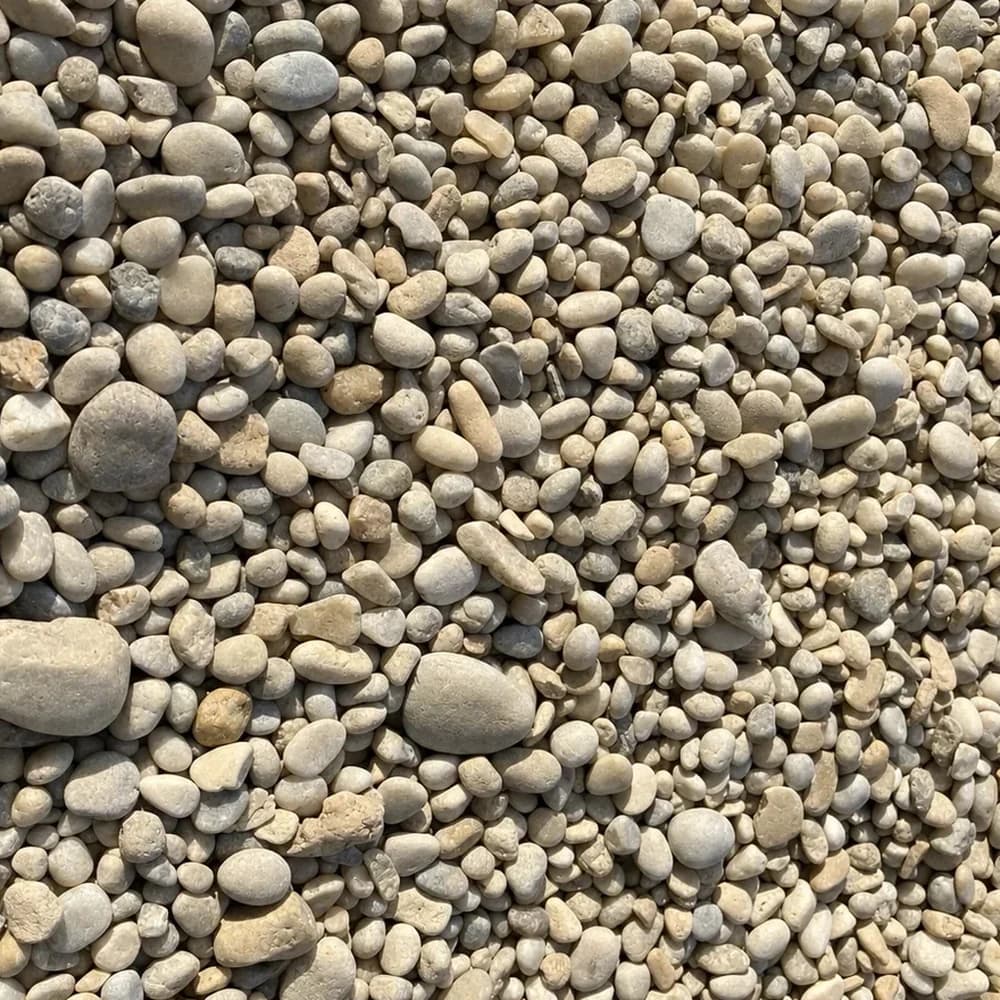
This is the figure that surprises people. Pea gravel feels soft and light underfoot, and it is published on this site at about 2,800 lb per cubic yard, which is 1.40 tons, the same as #57 and 3/4 inch crushed stone. The rounded shape packs with less empty space than it looks like it should, so the weight lands right alongside angular stone.
Coverage, per ton, follows from that: about 116 square feet at 2 inches, 77 at 3 inches, 58 at 4 inches, and only 19 at the 12 inches a fall zone needs. Which is why a play area is a bulk delivery and a fire ring is not.
The bucket you keep back for the traffic strip
The five percent option covers what the wheelbarrow spills and what ends up on the lawn. Beyond that, round up rather than down on anything people walk on. Loose stone does not stay evenly spread: a path develops a worn line down its middle within a year, and the fix is a bucket or two raked in, not a fresh delivery.
So keep a little back deliberately. A spare five-gallon bucket in the shed covers a season of topping up the line where feet actually go, and it saves ordering a fraction of a load later.
Where you should not round up is depth. Ordering 4 inches for a patio because it seems safer gives you a surface that swallows a chair leg and a table that never sits level. Put 2 inches of compacted stone screenings down first and 2 to 3 inches of pea gravel over it, and the surface stays firm without going deep.
Rounded or angular where the ground falls away
Round stone rolls. Almost every complaint about pea gravel traveling comes down to that, and it shows up in two places here.
The first is the border. Steel, aluminum, timber or paver edging set about an inch proud of the surface holds the stone in. Edging set flush lets it walk out over the first year, and a missing or sunken border is where you will find the gap. The second is water. A hard, fast downpour running across a gravel area will push rounded stone downhill regardless of edging, so on anything steeper than a gentle fall, either lay a honeycomb stabilizing grid under the gravel or pick an angular stone that interlocks and stays put.
Three tools handle loose stone on this site, and the job decides which:
- This page and Pea Gravel for comfort underfoot, at 1.40 tons per yard. Fire rings, dog runs, play areas, level paths.
- The gravel calculator for angular material, including walkway gravel on a sloping path and drive surfacing, at the same 1.40.
- The river rock calculator for decorative beds, borders and dry creeks, where the stone is larger and runs lighter at 1.35 tons per yard.
A long path can change material partway along, angular where it climbs and rounded where it levels out, and each stretch can be entered as its own area in the same estimate.
Getting three tons where you actually want it
Email yourself the estimate if you want it on your phone, then open the product page, set the tonnage and a date, and give the ZIP at checkout, which is where delivery is arranged. Ask for the drop as close to the run as the truck can safely get, on hard standing rather than lawn. Three tons of loose stone is a lot of wheelbarrow trips, and every foot you shorten that trip is worth more than it sounds at the start of the afternoon.
Common questions
What if I order half a ton too little?
You finish with the far end of the run bare, and the second trip costs more in handling than the stone. Round up to the next half ton. Spare pea gravel always finds a job, since it goes under a downspout, into a low spot or along a bed edge.
How close will this be to what I actually need?
On a level, edged area, close. The two things that throw it are a surface that was never properly graded, which quietly absorbs material into the dips, and a depth that creeps as you spread. Check yourself with a stick marked at 3 inches while you rake.
Which product page do I use once I have the number?
Pea Gravel for the 3/8 inch rounded stone this calculator is set for. If your estimate came out of the walkway or drive side of the job, that is a different product page and a different calculator.
Where should a delivery of loose stone be put down?
Somewhere flat, hard and close, with a tarp under it if it is going on a drive. Loose rounded stone spreads out under its own weight more than crushed material does, so allow more room for the pile than the yardage suggests.
Why does it give me both cubic yards and tons?
The area and depth you measured produce a volume, which is cubic yards. Stone is sold and hauled by weight, which is tons. At 1.40 tons per cubic yard the two figures are the same pile described twice, and having both lets you check an order against a measurement.
Related calculators
Under two tons covers most patios.
3/8 inch natural pea gravel, priced by the ton, delivered free.